

The Breech POWER Course is the outgrowth of two decades of collaboration between established Australian and Canadian breech providers and epidemiologists who have been involved in breech research in North America, Australia, and Europe.
We brought you the research on outcomes at centres in Frankfurt, Ottawa, Newcastle, and Sydney, and the two largest studies to date on Upright Vaginal Breech Birth.
Now the BABE course (Birthing a Breech Education) of Australia is joining with members of the National Breech Society of Canada (NBSC) in creating an online+in-person course.
BREECH POWER COURSE
POWER stands for:
Package of:
Online breech history/research, videos demonstrating manoeuvres
Workshop/conference for in-person hands on training (BABE course)
Experience in attending actual births in centres with high volume
Review: cases/videos/protocols with peers/experienced practitioners

More About the Online Breech Course
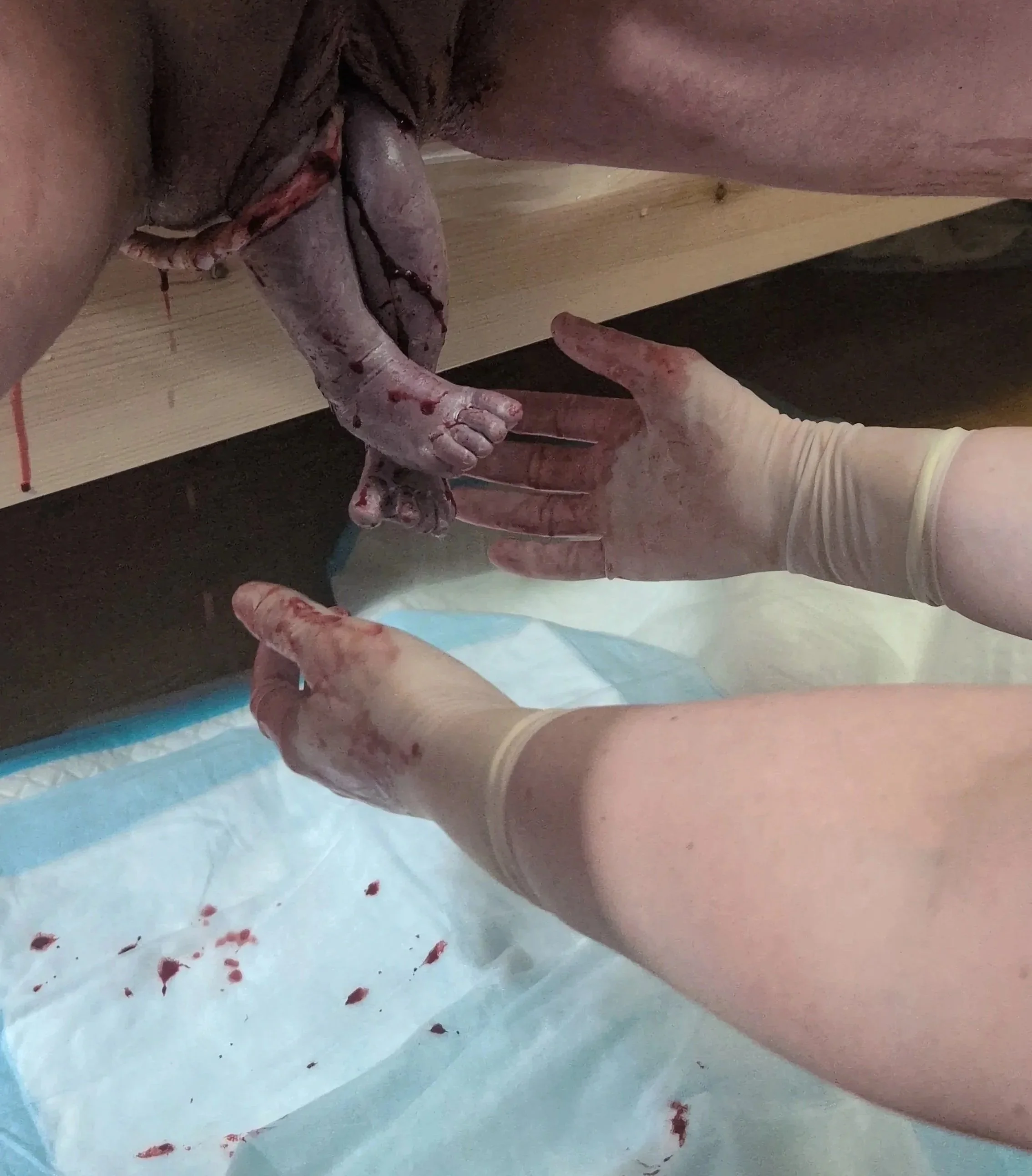
The online course modules feature videos that demonstrate how to do the manoeuvres in both the dorsal and upright positions. Sample videos of actual births show when and how effective the manoeuvres are.
The modules also have interviews and presentations of Australian, Canadian, and European breech providers, clinical epidemiologists, and ethnographers. They review the history and politics of breech birth and grapple with the controversies over best practice in management of breech during the pregnancy, labour, and birth, and best form of research to study outcomes.
Studies are reviewed and accessible on the online course and we will be using the Rethinking the Physiology of Vaginal Breech Birth in both Australia and Canada as a textbook.

In-Person Workshops: the BABE Course
(In Canada: "Birthing a Breech Event")
Our next conference, which will include skills training will be held in the GTA, Ontario, Canada. November 21-22, 2026 at a location to be announced.
Our inaugural conference was in Calgary, Alberta, Canada in November 2025 with obstetricians, family physicians and midwives coming to some strategies to bring back breech to Alberta using all of the professions who have breech in their scope of practice.
Presenters and trainers will be from obstetrics, midwifery,, and epidemiology.
In these in-person trainings, you will have the opportunity to engage in reviews of videos and do hands-on training on the Sophie Models and the new models being developed by Lisa Cowdery, midwife and trainer recently moved from Alberta to PEI.
Peer and Practice Review Arrangements for Breech Birth Attendance
Peers and practitioners with ample experience will hold private and group peer reviews. These will be on dates that will be identified on this website or for Canada on the National Breech Society of Canada Signal group.
Once you have attended one of the in-person sessions and taken the online modules, our Breech Attendance Committee will provide you with contacts to arrange to attend breeches locally or abroad in hospitals that identify as having larger breech birth attendance than the average. This will include Frankfurt, Ottawa (only for practitioners in Ottawa, Brockville and Kingston), Australia (largely only for Australians), Brazil and in the future, Mexico and possibly Africa.
Registration Options
ONLINE COURSE
$300 CAD
10+ hours of online education
2-DAY IN-PERSON CONFERENCE — TORONTO
$500 CAD
Early registration: $450 CAD by October 12
ONLINE + IN-PERSON
$700 CAD
Online course + 2-day Toronto conference
Save $100

Testimonials
Why Vaginal Breech Birth Has Continued to be an Option in Calgary
Dr. Bisits - Newcastle Breech Service Origins
Elisabeth Cisa-Pare, MD, Family Medicine Resident, Sudbury, Ontario, who struggled herself to access a vaginal breech delivery.
Why Andre Lalonde thinks we should continue to attend vaginal breech deliveries and teach it. (The present CEO of the International Childbirth Initiative, and the Vice Executive President of the Society of Obstetricians and Gyncecologists of Canada between 1991-2012)
Holly Umana, RM, Breech Practitioner and Instructor, Calgary

Why Practitioners Are Taking This Course
The main objective for practitioners through these courses is to update their skills at breech birth. The online course and videos will be available for you for 24 months.
The in-person workshops will continue to be called the BABE course but they will be intimately connected with the Breech POWER course and the Canadians have changed the acronym BABE to spell out '“Birthing a Breech Event,” because it is quite a process.
If in the future practitioners want us to travel to other countries to provide a course, we are open, but most of us have busy practices and cannot do that as frequently as we may like, especially if we are the only vaginal breech provider in town willing to be on call. You can contact us at breechpowercourse@gmail.com.
*”Upright was defined in our Frankfurt article to include on hands and knees, on the knees leaning over a couch or the back of the hospital bed, on the birth stool, squatting, or standing.
Collaboration Among
Obstetricians, Family Physicians, Midwives, Nurses,Neonatologists and Epidemiologists
Purpose of the Course
The purpose of the course is to create a safe space for all health care practitioners to be exposed to new ideas and develop together a better understanding of breech management—online, at workshops and conferences, and at actual births. Midwives and physicians have been saying they know their Colleges support their offering vaginal breech but they don’t feel personally comfortable doing so without enough training or hands-on opportunity. We intend to have this course provide you with the missing gaps along with accreditation for the efforts you are putting into learning.
We find it useful in our present milieu to create an online community of providers that can bring their difficult breech births to each other and to more experienced breech providers to offer help at actual births or to debrief them. Online peer review can become necessary if it is difficult to find somebody in your own jurisdiction with enough breech experience or there is hostility about your provision of breech care in your community and you have had a bad case. You may need a second opinion for collegial support and defence of what you did.
Vaginal Breech on the Back or Upright
While the burgeoning research demonstrates that upright breech* reduces manoeuvres, and may improve neonatal outcomes and reduce cesareans, we acknowledge that some practitioners remain more confident using the dorsal manoeuvres. In addition. if a birthing person chooses to birth with an epidural and “walking” epidurals are not available, birth on the back may become necessary. We want to reinforce that offering vaginal breech is the key & can be accomplished in many different positions. Therefore we teach manoeuvres for both dorsal and upright breech birth.
Introduction to the Online Breech POWER Course
Dr. Meriah Fahey, Calgary
Professor Betty-Anne Daviss, Ottawa
Dr. Ken Johnson, Ottawa
Dr. Andrew Bisits, Sydney
Note: It is necessary to register for the online course either separately or in tandem with a breech workshop or conference.
Module Curriculum
Note: Modules are in process. Module 1 and 5 are up and Module 7 should be up soon. We are adopting to changes in it, bolstered by the success of the Calgary Conference and new videos coming to us regularly now. We are waiting for confirmation for the use of some of them.The other modules will be up over the next few months. Email breechpowercourse@gmail.com for any further questions for help with the modules or questions about them.
Module 1: Introduction: Videos of Vaginal Breech Births in the Upright Position, no manoeuvres required. Why Physicians and Midwives Continue to Offer Vaginal Breech Birth and the Epidemiologists support it.
Module 2: The History of Breech, the Manoeuvres on the Back, the Evolution of the New Positions for breech.
Module 3: Early Research and the Term Breech Trial; the limitations of the RCT in Obstetric/Midwifery Practice. the meta analysis of the risks of vaginal vs. cesarean section for birthing persons.
Module 4: Cohort Studies Using Traditional Medical Management on the Back and Interviews with the Practitioners and Researchers Involved
Module 5: The Upright Breech Birth Studies
Module 6: Prenatal Management
Dealing with the Fear, General Management Prenatally, Ultrasound and MRIs, (ultrasounds, potential MRI if baby looks over 4000g)
Inclusion/Exclusion Category
Module 7: The Normal Breech Birth Mechanisms of Descent of the Breech Baby and the optimal positioning
Module 8: Breech Management in Labour
Lesson 1 PROM: To Induce or Not to Induce
Lesson 2 Electronic Fetal Monitoring Controversies
Lesson 3: Compromised fetal Heart tone and exhausted mother: Fundal Pressure the controversies and established practice.
Lesson 4: Releasing the Arms
Lesson 5: The Head: positioning first, the Frank Nudge, and the Crowning Touch.
Lesson 6: Videos demonstrating more complicated scenarios needing several manoeuvres.Management and its Controversie
Module 8: Controversies in Management